
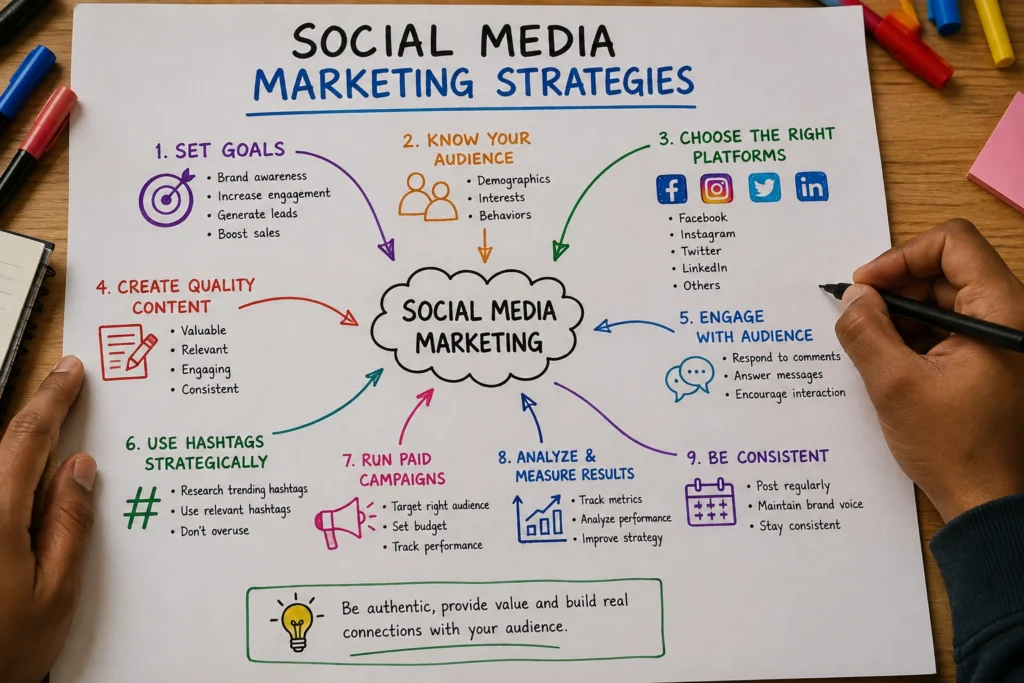
I’ve clicked on more “ultimate guides” to social media than I’d like to admit, and honestly, most of them are the same ten tips wearing a different outfit. This one’s my attempt to skip past that and just talk about what moves an account forward. Because a lot of the advice out there doesn’t.
Here’s the thing nobody wants to say outright: posting because you’re supposed to doesn’t grow anything by itself. You need a plan, some consistency, a willingness to try things that might flop, and — the part everyone underrates — actually looking at your own numbers instead of guessing.
So if you’re running Instagram for a two-person startup, or you’re the person handling social for a company that’s been around since before you were born, here’s what I’ve seen indeed work.
There are billions of people on Facebook, Instagram, LinkedIn, X, TikTok, online pinboard, and YouTube at this precise instant. If your brand’s nowhere in that mix, you’re just Depart people on the table. And it’s not only about visibility anymore — people research products on social before they ever land on a website. They form an opinion about your company just from scrolling past your feed, whether you meant for that to happen or not.
Do it well and you get a few things at once: a real shot at a global audience instead of a local one, more traffic, better relationships with people who already buy from you, leads that are actually worth chasing, and — this one surprises people — a genuinely useful window into what customers want. All for a fraction of what traditional advertising costs.
Get specific about what you actually want
“Grow our social media” isn’t a goal. It’s a wish that put on a tie. Before you write a single caption, pin down something you can measure. Grow followers by 20%. Pull 500 visits a month from social. Move the engagement rate. Sell more of one specific product. Bring in leads that are actually worth following up on.
Vague goals just kind of sit there. Specific ones tell you whether what you’re doing is working.
Know who you’re actually talking to
Everyone skips this step, and it shows up in the content every time — you can just tell. Age, location, pursuits, how people In fact conduct online, what they buy (not what they claim they’d buy), what’s Really worrying them. The more you understand this, the less your posts sound like they’re talking *at* someone alternatively of *to* them.
You don’t need to be on every platform
Trying to show up everywhere is a pretty reliable way to be forgettable everywhere. Facebook still does the job for local businesses and community stuff. Instagram is where anything visual lives — food, fashion, travel, most influencer work. LinkedIn is your B2B and hiring and thought-leadership lane. TikTok is short video and your best real shot at going viral. YouTube is for something that needs more than 60 seconds to land — tutorials, demos, that sort of thing.
Pick two or three where your actual public already hangs out, and be Really good there. That beats being mediocre on five.
Content has to be worth someone’s time
This is still the Vertebrae of everything. Good content teaches something, Amuses, encourages, solves a real problem, or gets people Indeed typing in the comments instead of just paging past. Photos, short-form video, Reels, Stories, live streams, polls, behind-the-scenes stuff, customer testimonials — all fair game. Posting less but better beats Grating out middling content on a schedule just because the schedule says Tuesday.
A content calendar helps here too — dates, platforms, formats, captions, what campaign it ties back to. Let a scheduling tool handle the busywork so your energy goes toward the stuff that actually needs a brain.
Video, by the way, isn’t a “trend” anymore. It hasn’t been for a while. It’s just how this works now — tutorials, reviews, behind-the-scenes clips, quick tips, live Q&As. Short-form especially travels faster and further than a static post ever will.
Social media is a conversation, not a bulletin board you pin things to and walk away from. Reply to comments, DMs, reviews, mentions — and do it reasonably fast. It’s one of the cheapest ways to build trust that exists, and it’s the thing most brands quietly stop doing after month two.
Hashtags, but with some restraint
They still help people find you, if you’re not sloppy about it. Stay relevant, mix a couple of big ones with smaller niche ones, don’t cram twenty into a caption like you’re trying to win a contest, and build a branded tag for campaigns worth tracking.
Influencers, chosen carefully
alliance can lend real reliability, but only with people who actually share your brand’s values and have an audience that’s engaged preferably than just large. Micro-influencers are often the smarter move — smaller numbers, but the appointment is usually real, and it costs a lot less.
Paid ads still matter
Organic reach only takes you so far, Especially with platforms tilting harder toward paid content every year. Ads get you in front of people who don’t already follow you, push transitions, and let you retarget the ones who Inspected but didn’t buy. Use the targeting tools you’re given. They’re there so you spend smarter, not just more.
Your profile is doing more work than you think
It’s often the very first impression someone gets of your brand. A professional photo, a bio that actually says something, contact info, a link to your site, consistent branding, business details that are current — a half-finished profile quietly undercuts everything else you’re doing, even the good stuff.
Let your customers make your content for you
User-generated content — real photos, reviews, testimonials — tends to convert better than anything a brand produces in-house. It’s trusted more, feels more real, and tends to build an actual sense of community around the brand. Give people an easy reason to share their experience and a lot of them will.
Look at your analytics. Actually look.
Reach, impressions, engagement rate, click-through, follower growth, conversions — track it, and then actually change something based on what you find. Data nobody looks at isn’t doing anything for anyone.
Stay consistent
Easy to say, harder to Indeed do. Keep the posting schedule firm. Keep your voice and visual style the same everywhere you show up. That steadiness is what makes a brand recognizable in the first place, and distinguishable brands earn trust faster.
Let customers do the talking
Reviews, case studies, success stories — this is social proof, and it beats brand copy every time, because people trust other people more than they trust a company talking about itself.
Things that quietly wreck an otherwise decent strategy
Posting in bursts and then disappearing for three weeks. Letting comments pile up unanswered. Buying followers — genuinely, it has never once helped anyone, ever. Publishing low-effort content just to hit a share. identifier that don’t fit the post. change every single post into a sales pitch. Never checking the analytics. Copy-pasting the same post across five platforms without adapting a word of it.
What’s coming
AI-assisted content becoming the default instead of the novelty. Short-form video staying on top. Social business— buying without ever departing the app. Deeper influencer bond instead of one-off posts. More personalization. Community-driven engagement instead of broadcast-style posting. Live streaming sticking around. More interactive stuff, polls and quizzes and the like.
Brands that start experimenting early tend to have a real edge once all this goes fully mainstream.
Before you launch, ask yourself
Do you have clear goals? Do you actually know your audience, or just a rough sketch of them? Right platforms? Content that’s genuinely worth someone’s time? Visuals that look good? A schedule you can actually keep? Are you engaging with people, not just posting at them? Do the Tag make sense? Is anyone checking the analytics? Are the profiles refined? Is paid advertising even on the table? And are you willing to keep adjusting as you go, instead of setting it and mislaying it?
Bottom line
This was never really about posting. It’s about building an actual relationship with people who might buy from you eventually. Set real goals, understand who you’re talking to, make Objects worth someone’s time, use video, pick the right partners, and pay focus to what the numbers are Truth telling you.
nothing of it transpires overnight, and anyone who tells you differently is selling something. Stay Constant, stay curious, listen more than you broadcast, and keep enhancing. Do that long enough and social media becomes one of the most successful tools you’ve got for indeed growing a brand.