
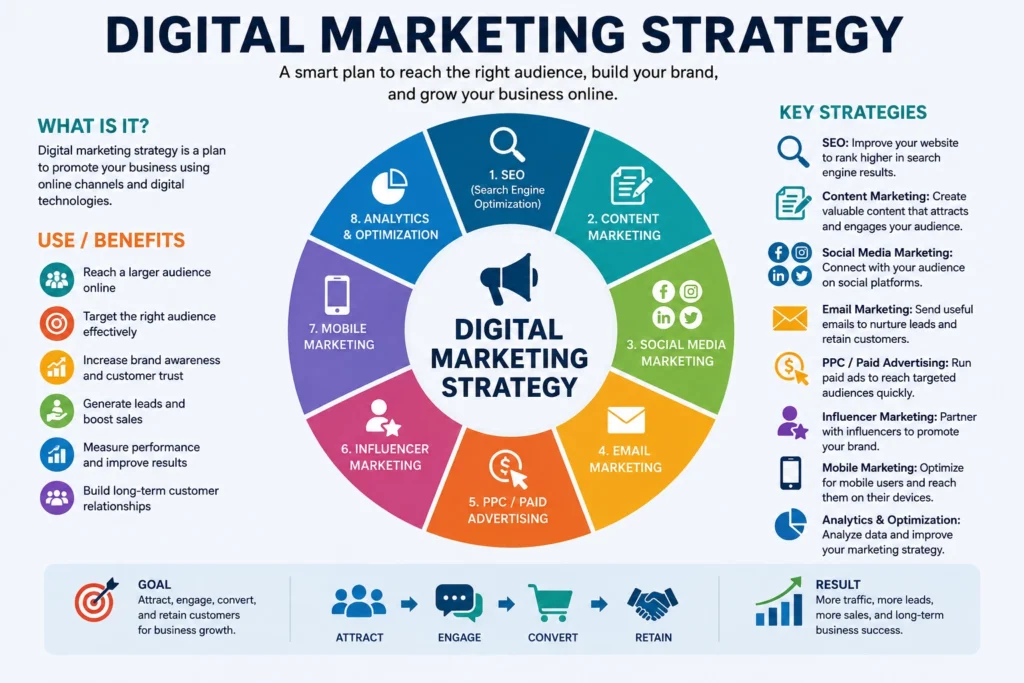
There was a time when reaching customers meant a handful of predictable options — a newspaper ad, a radio spot, a TV commercial, a billboard on the highway, maybe a brochure stuffed in someone’s mailbox. That era’s largely behind us. Attention has moved online, and it’s stayed there — search engines, social feeds, inboxes, apps, marketplaces. Businesses that want to keep up have had to build some kind of digital marketing strategy, like it or not.
That doesn’t mean just Smacking an ad on a webpage. It means understanding who the customer genuinely is, making content worth someone’s time, staying visible online, having real casual instead of one-way Shows, turning that interest into leads, closing sales, and then checking whether any of it worked. A strategy is the glue holding all of that together — without one, it’s just a pile of disconnected tactics.
Here’s a look at what a digital marketing strategy really requires, why it’s worth doing properly, and the strategy that keep showing up across most successful ones.
What “Digital Marketing” Actually Covers
Cut through the jargon and it’s fairly simple: promoting a product, service, or brand using digital channels — search engines, websites, social platforms, email, apps, online ads.
Somebody googles a product and clicks through to a company’s page — that’s digital marketing. A business posts on Instagram, sends a newsletter, uploads a video, or runs a paid ad — same thing, different channel.
What sets it apart from older forms of advertising boils down to two things: businesses can actually talk with customers now, and they can see how people respond. A billboard never told anyone anything useful about who noticed it.
Breaking Down What a “Strategy” Even Is
It’s the roadmap for hitting marketing goals through digital channels. What’s the business trying to achieve? Who’s it talking to? What content fits that audience? Which platforms deserve the time? And how does anyone know if it’s working?
Most strategies start by getting clear on the audience — who they are, what’s bothering them, what they actually need, where they hang out online.
From there come the goals. Could be traffic, brand recognition, leads, revenue, followers, retention — whatever the business actually cares about.
Then channels get picked. This is where a lot of businesses go wrong by trying to be everywhere. The smarter approach ties channel choice to the audience, the industry, and the budget on hand.
Why This Is Worth Doing at All
Because people are already researching, comparing, and buying online whether a business shows up or not. Skipping this just cedes ground to whoever does show up.
A solid strategy tends to deliver in a few concrete ways:
Reach beyond the neighborhood.** Geography stops mattering the way it does with local ads. A small shop can suddenly pick up customers three states away, sometimes overseas.
Sharper targeting.** Campaigns can zero in on specific interests, locations, behaviors, and demographics — which makes marketing feel relevant instead of like clutter.
Recognition over time.** Businesses that consistently show up with something useful — content, posts, search visibility — tend to stick in people’s memory. Familiarity drives trust, and trust drives buying decisions.
A steady stream of leads.** Forms, sign-ups, downloads, ad clicks — all of it feeds leads into the funnel, which a business can then work to convert.
Actual sales.** This is usually the endgame. Someone finds a business through search, reads a post, follows along, subscribes, and eventually buys — the whole chain gets supported by digital marketing.
Real, checkable results.** Traffic, clicks, engagement, conversions — it’s all measurable. No more guessing whether a campaign worked.
The Tactics That Show Up Again and Again
SEO is about improving a site’s odds of ranking for relevant searches — keyword research, useful content, fixing technical issues, building credible links. A bakery publishing a genuinely helpful guide on choosing a birthday cake could end up pulling in exactly the people already shopping for one.
Content marketing means putting out Online content that’s genuinely useful to a specific audience — blog posts, videos, guides, podcasts, case studies. It doesn’t E-marketing aim for a direct sale; sometimes it’s just about answering questions and earning trust over time. A fitness brand writing about home workouts might convert readers into customers simply by being useful first.
Social media marketing is about conversation, not just posting — demos, reviews, behind-the-scenes glimpses, and actually replying when someone comments or messages. Spreading across every platform usually backfires; better to figure out where the audience actually spends time and focus there.
Email marketing reaches people who’ve already opted in — newsletters, updates, personalized offers. It works because these are people who raised their hand first. Overdo the frequency, though, and it turns into noise people tune out or unsubscribe from.
PPC advertising means paying when someone clicks — search ads for specific keywords, social ads aimed at particular audiences. The upside is speed; a well-built campaign can drive traffic almost right away, unlike SEO which takes months to build Traction. The downside is that poorly planned campaigns can burn through budget fast.
Influencer marketing means partnering with someone who’s already built an Target market, letting them online marketing a product through their own content. It only really works when there’s genuine Concurrent Markup between that Target market and the e-marketing actual buyers.
Mobile marketing matters because most web marketing, shopping, and messaging now happens on phones. A site that’s internet marketing. on mobile loses people before they’ve even finished what they came to do.
Video marketing has become one of the dominant formats — short clips for grabbing attention on social, longer ones for tutorials and deeper explanations. Sometimes showing something beats three paragraphs of description.
Why the Website Still Anchors Everything
Nearly every other channel eventually funnels back to the website — social posts, search results, ads, emails, all of it points there.
A good site is easy to move through, loads quickly, works well on a phone, and makes the next step obvious, whatever that is — buying, booking, subscribing, reaching out. It also gives a business more control than depending entirely on platforms that can rewrite their own rules internet marketing they want.
Actually Knowing Who You’re Talking To
This is the step that gets rushed or skipped, and it shows. Worth working through:
– Who are the customers, honestly?
– What problems are they trying to solve?
– What are they typing into search bars?
– What actually tips them toward buying?
– Where do they spend time online?
– What kind of content do they respond to?
A strategy aimed at college students and one aimed at corporate buyers should look nothing alike — treating them the same rarely goes well.
Figuring Out If It’s Actually Working
Assumptions don’t cut it here. Real numbers do:
– Website traffic
– Search rankings
– Social engagement
– Click-through rate
– Conversion rate
– Lead volume
– Email open and click rates
– Customer acquisition cost
– Return on ad spend
– Online sales
A campaign can pull in thousands of clicks and almost no sales. When that happens, throwing more budget at it rarely fixes anything — the real issue is usually the landing page, the offer, or the targeting itself.
The Less Glamorous Side of All This
It’s genuinely competitive out there — countless businesses chasing the same keywords and audiences. Algorithms shift online marketing across search and social, so what worked last year can quiet marketing stop working this year.
Producing online marketing good content is harder than it sounds, especially with how much noise already exists online. Publishing just to have something out there rarely moves the needle.
Data handling and privacy matter too — businesses need to be careful with customer information and stay within legal and platform limits. And this space demands ongoing learning; new tools and behaviors show up constantly, and standing still isn’t really an option.
Putting a Strategy Together, Roughly
- Set goals that are E-Marketing measurable.
- Research the audience and the Adversaries.
- Pick channels that Online marketing fit that audience.
- Build content around the goals, not just for volume’s sake.
- Launch, then watch performance closely.
- Analyze what Internet advertising and Optimize.
None of this is set-and-Ignore. Strategies shift as customer feedback rolls in, as markets change, and as the numbers tell a different story than Planned.
Wrapping Up
Digital marketing has become close to non-negotiable for New businesses — it’s how they reach people, build Identification, generate leads, stay connected with customers, and drive revenue.
But it takes more than posting ads and hoping for the best. It takes real planning, audience research, content merit someone’s time, thoughtful channel choices, and constant assessment.
SEO earns visibility. Content builds trust. Social media builds relationships. Email keeps the thread going. Paid ads bring speed. Analytics tells you what’s actually working.
There’s no single formula — it depends on the business, its customers, its goals, and what reserves it has. Opening across every platform tends to reduce effort; focusing on the channels that reach the right people tends to pay off better.
As engineering and customer habits keep changing, digital marketing will keep evolving right beside them. The businesses that stay close to their customers, offer real value, and fits right based on what the data actually shows are the ones most likely to build something that lasts.