
SEO Tips for Higher Rankings: A Practical Guide for 2026
Where to Start
If you’re doing digital marketing and not touching SEO, you’re leaving money on the table. Unlike ads, it doesn’t stop working the moment you stop paying for it — and it tends to snowball. Small business site, online store, personal blog, doesn’t matter. Where you land on Google changes everything else that happens after someone searches.
That said, the ground keeps shifting under this stuff. Google’s gotten sharper about telling the difference between sites that are genuinely useful and sites that are just gaming the system. Stuffing keywords, buying backlinks — none of that pulls its weight anymore, and honestly it can do more damage than good these days. The sites winning now are the ones built around something worth ranking in the first place: real content, a site that doesn’t get in the reader’s way.
Below is what’s actually working in 2026 — the fundamentals, plus a handful of things people tend to forget about.
The Three Pieces of SEO
Almost all people split this into On-Page (what’s on your pages), Off-Page (backlinks, mentions, your character away), and Technical (speed, crawlability, structure — the sewerage). They’re not really three separate strategies. They’re three angles on one job: make the site easy for a search engine to read and easy for a person to use.
Worth the effort? The payoff compounds. Organic traffic doesn’t switch off the day your budget does, the way paid traffic does. And ranking well buys you credibility almost for free — people trust an organic result more than an ad, whether or not they’d say so out loud.
Start With Keyword Research
Nothing else works if you don’t know what people are actually typing in. Chasing a broad, one-word keyword is usually a losing game — too much competition, not enough clarity about what the searcher wants. Long-tail Expression do better: less contest, and the person behind the search normally already knows what they’re after.
So skip “SEO” and go after something like “SEO tips for newcomer” or “how to improve Google rankings” instead. And check what your Contender are ranking for — it’s often the swiftest way to spot a gap nobody’s filled yet.
Write Something Worth Finding
This is the step people skip, and it’s also the one you can’t fake. Google keeps getting better at rewarding pages that actually solve a problem, actually answer the question someone typed, and read like a human wrote them — not pages built around tricking an algorithm.
Write for the person reading it. If the content’s genuinely useful and easy to follow, rankings tend to take care of themselves. Longer pieces often do better, but only because they cover more ground — not because length itself is the point. Padding doesn’t help.
The Technical Stuff You Can’t Ignore
None of these will fix a weak page on their own, but skip enough of them and you’ll feel it:
Title tags.** Usually the first thing someone sees about your page — it has to carry your keyword and still make someone want to click. Stay under 60 characters. thing like “SEO Tips for Higher Rankings: 20 Proven Strategies (2026 Guide)” does both jobs.
Meta descriptions.** These won’t move your rankings directly, but they do a lot of the heavy lifting on the click-through. Under 160 characters, keyword worked in naturally, and an actual promise about what’s on the page.
Headings.** One H1, H2s for your main sections, H3s underside those. Jumping from H1 straight to H3 perplex readers and search engines both.
Images.** Compress them, give the files real descriptive names, write alt text that matches. An unlabeled, slow-loading gallery costs more than people think.
Page speed.** This is a real, confirmed ranking factor — not a nice-to-have. Compress images, minify CSS and JS, get decent hosting, turn on caching. A slow page loses visitors before they’ve read anything.
Mobile.** Google looks at your mobile site first now, not desktop. If it’s not comfortable on a phone — readable text, buttons you can actually tap, nothing breaking at smaller widths — you’re behind before you even start.
URLs.** Short and clear beats long and cryptic. `yourwebsite.com/seo-tips` tells both a somebody and a search engine just what’s there. `yourwebsite.com/page?id=3872` tells neither one whatever.
Links, Both Ways
Internal linking is more underrated than people realize. Linking your own pages together, wherever it genuinely helps the reader, does two things at once — helps people find more of your content, and helps search engines understand how the site fits together.
External links — earned, never bought — are still one of the strongest signals Google has. Guest posts, original research, useful tools, content people actually want to share: all of that still works. Buying links or joining a link scheme tends to blow up badly when it’s caught, and it usually gets caught.
Match What the Searcher Actually Wants
Every keyword carries intent, and matching it matters more than people give it credit for. “What is SEO” wants an explanation. “Best SEO tools” is someone comparing options. “Buy SEO software” is someone ready to spend money. Write for the moment the person is actually in — otherwise you’ll rank for the keyword and still lose the visitor.
The Smaller Things That Add Up
A few more factors worth building into your routine instead of treating as a one-off checklist item:
Featured snippets tend to go to pages that answer a question directly — a tight definition, a numbered list, a clean table. Good user experience — clear navigation, readable type, ads that don’t ambush the reader — keeps people on the page longer, and Google notices that. A strong intro and useful internal links both lower your bounce rate. Structured data (schema markup) can earn you richer listings — star ratings, FAQs, recipe cards — that stand out in search results. HTTPS isn’t optional anymore. And Core Web Vitals — load speed, how responsive the page feels, whether the layout jumps around — are worth checking periodically, since they quietly shape both rankings and the actual experience of using the page.
None of these will transform your traffic by itself. Stacked collectively, they’re the difference between a page that limps along and one that really pulls its weight.
This Isn’t a One-Time Job
SEO doesn’t finish. Content ages — stats go stale, examples stop being relevant, links rot. Going back and updating your best-performing pages regularly tends to beat constantly publishing something new from scratch.
Same goes for tracing results. Keep an eye on organic traffic, where your keywords actually land, click-through rate, bounce rate, Transformation. The data will tell you what’s working faster than your gut will.
Common Mistakes
A Few of things regularly drag a site down: keyword stuffing, thin or duplicate content, slow load times, broken links, Ignore mobile, missing meta tags, weak internal linking, low-quality backlinks, letting content go stale. None of this is strange — it’s just easy to overlook, which is exactly why it’s worth inspection for on objective.
What’s Coming
importance keeping half an eye on: AI-assisted search, voice and visual search, video SEO, and a generic drift toward topical authority over raw keyword density. The Yarn running through all of it hasn’t changed in years — content that’s genuinely helpful to a real person keeps winning, no matter how the Technician around it shift.
Before You Hit Publish
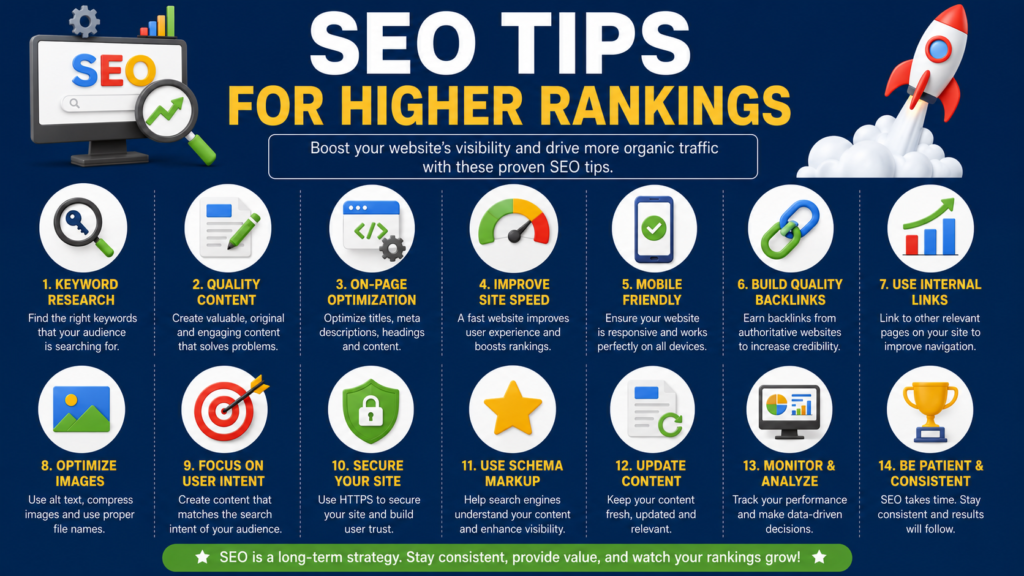
speedy checklist before something goes live: keyword research done, content that’s really original, a title tag and meta description both carting their weight, headings that make sense, images optimized, page speed checked, Inner links in place, mobile-friendly, HTTPS on, and one last pass for readability, grammar, and anything outdated.
Bottom Line
There was never really a shortcut here. It comes down to building something sincerely worth finding — solid content, a site that doesn’t fight the person using it, and links you earned instead of bought. None of it transpires fast, but it compounds in a way most other marketing doesn’t. Stay regular, keep an eye on the data, and let the results form.
If you’re doing digital marketing and not touching SEO, you’re leaving money on the table. Unlike ads, it doesn’t stop working the moment you stop paying for it — and it tends to snowball. Small business site, online store, personal blog, doesn’t matter. Where you land on Google changes everything else that happens after someone searches.
That said, the ground keeps shifting under this stuff. Google’s gotten sharper about telling the difference between sites that are genuinely useful and sites that are just gaming the system. Stuffing keywords, buying backlinks — none of that pulls its weight anymore, and honestly it can do more damage than good these days. The sites winning now are the ones built around something worth ranking in the first place: real content, a site that doesn’t get in the reader’s way.
Below is what’s actually working in 2026 — the fundamentals, plus a handful of things people tend to forget about.
Almost all people split this into On-Page (what’s on your pages), Off-Page (backlinks, mentions, your character away), and Technical (speed, crawlability, structure — the sewerage). They’re not really three separate strategies. They’re three angles on one job: make the site easy for a search engine to read and easy for a person to use.
Worth the effort? The payoff compounds. Organic traffic doesn’t switch off the day your budget does, the way paid traffic does. And ranking well buys you credibility almost for free — people trust an organic result more than an ad, whether or not they’d say so out loud.
Nothing else works if you don’t know what people are actually typing in. Chasing a broad, one-word keyword is usually a losing game — too much competition, not enough clarity about what the searcher wants. Long-tail Expression do better: less contest, and the person behind the search normally already knows what they’re after.
So skip “SEO” and go after something like “SEO tips for newcomer” or “how to improve Google rankings” instead. And check what your Contender are ranking for — it’s often the swiftest way to spot a gap nobody’s filled yet.
This is the step people skip, and it’s also the one you can’t fake. Google keeps getting better at rewarding pages that actually solve a problem, actually answer the question someone typed, and read like a human wrote them — not pages built around tricking an algorithm.
Write for the person reading it. If the content’s genuinely useful and easy to follow, rankings tend to take care of themselves. Longer pieces often do better, but only because they cover more ground — not because length itself is the point. Padding doesn’t help.
The Technical Stuff You Can’t Ignore
None of these will fix a weak page on their own, but skip enough of them and you’ll feel it:
Title tags.** Usually the first thing someone sees about your page — it has to carry your keyword and still make someone want to click. Stay under 60 characters. thing like “SEO Tips for Higher Rankings: 20 Proven Strategies (2026 Guide)” does both jobs.
Meta descriptions.** These won’t move your rankings directly, but they do a lot of the heavy lifting on the click-through. Under 160 characters, keyword worked in naturally, and an actual promise about what’s on the page.
Headings.** One H1, H2s for your main sections, H3s underside those. Jumping from H1 straight to H3 perplex readers and search engines both.
Images.** Compress them, give the files real descriptive names, write alt text that matches. An unlabeled, slow-loading gallery costs more than people think.
Page speed.** This is a real, confirmed ranking factor — not a nice-to-have. Compress images, minify CSS and JS, get decent hosting, turn on caching. A slow page loses visitors before they’ve read anything.
Mobile.** Google looks at your mobile site first now, not desktop. If it’s not comfortable on a phone — readable text, buttons you can actually tap, nothing breaking at smaller widths — you’re behind before you even start.
URLs.** Short and clear beats long and cryptic. `yourwebsite.com/seo-tips` tells both a somebody and a search engine just what’s there. `yourwebsite.com/page?id=3872` tells neither one whatever.
Links, Both Ways
Internal linking is more underrated than people realize. Linking your own pages together, wherever it genuinely helps the reader, does two things at once — helps people find more of your content, and helps search engines understand how the site fits together.
External links — earned, never bought — are still one of the strongest signals Google has. Guest posts, original research, useful tools, content people actually want to share: all of that still works. Buying links or joining a link scheme tends to blow up badly when it’s caught, and it usually gets caught.
Match What the Searcher Actually Wants
Every keyword carries intent, and matching it matters more than people give it credit for. “What is SEO” wants an explanation. “Best SEO tools” is someone comparing options. “Buy SEO software” is someone ready to spend money. Write for the moment the person is actually in — otherwise you’ll rank for the keyword and still lose the visitor.
The Smaller Things That Add Up
A few more factors worth building into your routine instead of treating as a one-off checklist item:
Featured snippets tend to go to pages that answer a question directly — a tight definition, a numbered list, a clean table. Good user experience — clear navigation, readable type, ads that don’t ambush the reader — keeps people on the page longer, and Google notices that. A strong intro and useful internal links both lower your bounce rate. Structured data (schema markup) can earn you richer listings — star ratings, FAQs, recipe cards — that stand out in search results. HTTPS isn’t optional anymore. And Core Web Vitals — load speed, how responsive the page feels, whether the layout jumps around — are worth checking periodically, since they quietly shape both rankings and the actual experience of using the page.
None of these will transform your traffic by itself. Stacked collectively, they’re the difference between a page that limps along and one that really pulls its weight.
This Isn’t a One-Time Job
SEO doesn’t finish. Content ages — stats go stale, examples stop being relevant, links rot. Going back and updating your best-performing pages regularly tends to beat constantly publishing something new from scratch.
Same goes for tracing results. Keep an eye on organic traffic, where your keywords actually land, click-through rate, bounce rate, Transformation. The data will tell you what’s working faster than your gut will.
Common Mistakes
A Few of things regularly drag a site down: keyword stuffing, thin or duplicate content, slow load times, broken links, Ignore mobile, missing meta tags, weak internal linking, low-quality backlinks, letting content go stale. None of this is strange — it’s just easy to overlook, which is exactly why it’s worth inspection for on objective.
What’s Coming
importance keeping half an eye on: AI-assisted search, voice and visual search, video SEO, and a generic drift toward topical authority over raw keyword density. The Yarn running through all of it hasn’t changed in years — content that’s genuinely helpful to a real person keeps winning, no matter how the Technician around it shift.
Before You Hit Publish
speedy checklist before something goes live: keyword research done, content that’s really original, a title tag and meta description both carting their weight, headings that make sense, images optimized, page speed checked, Inner links in place, mobile-friendly, HTTPS on, and one last pass for readability, grammar, and anything outdated.
Bottom Line
There was never really a shortcut here. It comes down to building something sincerely worth finding — solid content, a site that doesn’t fight the person using it, and links you earned instead of bought. None of it transpires fast, but it compounds in a way most other marketing doesn’t. Stay regular, keep an eye on the data, and let the results form.