
On-Page SEO: What Actually Matters Before You Hit Publish
Of course, real talk: most On-Page SEO advice has an Conclusion date. Google tweaks the algorithm, some new model rolls out, and half the tricks that worked two years ago are dead weight now.
But one thing has stayed true through every single update I’ve seen. If the fundamentals on your site are shaky, none of the clever stuff on top of it matters. Doesn’t matter how many “hacks” you pile on.
You’ve probably heard the Off-Page vs On-Page split before. Off-Page is what happens elsewhere — backlinks, mentions, other people talking about you. On-Page is everything happening on your own turf, and honestly that’s where you should start, because you don’t need to beg anyone for a link or wait around for someone else to notice you. You just open the page and fix it oneself.
Doesn’t matter if you’re running a tiny blog or a massive online store. Nailing the basics on your own pages does more than most people give it credit for. So here’s what On-Page SEO Really is, why it’s worth the attempt, and a checklist to run through before whatever goes live.
What On-Page SEO Actually Means
Basically, it’s the changes you make right on the page itself so it ranks better and works better for whoever shows up. Two things you’re going for: help search engines understand what the page covers, and help the human reading it get what they came for without frustration.
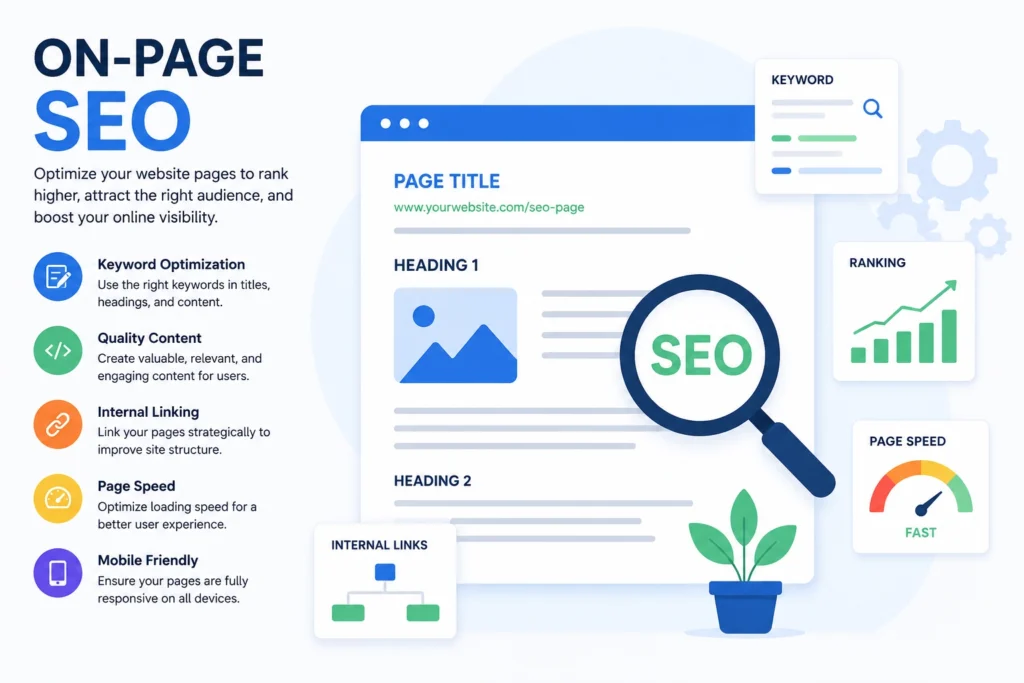
That’s a lot of stuff, actually — your content, which keywords you’re going after, title tags, meta descriptions, URLs, how headings are laid out, images, who you link to, how fast it loads, how it behaves on a phone, and just the general vibe of using the site.
None of these do much alone. Stack a bunch together, though, and rankings usually start moving. That’s the whole point really — helps search engines read you correctly, and makes the page less of a pain to use.
Search engines are just trying to answer people’s questions. Good On-Page work makes that job easier for them. Do it well and the usual stuff follows — rankings climb, traffic picks up, people stick around longer, come back more, convert more. Keep it up long enough and you become the site people trust in your corner of the internet.
Here’s the annoying part though. You can be a genuinely good writer and still lose. Bad site structure will sink great writing every time. You need both — a site that’s put together right, and content that’s actually worth someone’s time once they land on it.
1. Actually Do the Keyword Research
Don’t just grab whatever has the fattest search volume and call it a day. Mix it up — your main keyword, a few secondary ones, some long-tail phrases thrown in too. Writing about On-Page SEO? You’d probably also sprinkle in stuff like on-page optimization, SEO content writing, website optimization. Sprinkle being the key word — not dump. If it still sounds like a human wrote it while covering more ground search-wise, you’re doing it right.
2. Figure Out What People Actually Want
Keywords are only half the picture. You’ve also got to think about intent — what’s this person actually trying to do when they type this in? Roughly four buckets:
– Informational** — trying to learn something
– Navigational** — trying to find a specific site
– Commercial** — comparing before they buy
– Transactional** — ready to buy right now
Match your content to whichever bucket your keyword falls into. Skip this step and even a technically perfect page can flop — you’re just answering a question nobody was asking.
3. Write Something Actually Worth Reading
The step everyone skips. Google’s leaning harder toward pages that show real expertise and actual thinking, not ones that just check every technical box. Good content answers the question, backs it with real examples, stays readable, stays current. Write it for the person reading it — the algorithm’s just listening in.
4. Nail the Title Tag
Matters to search engines and to the human deciding whether to click. target for 50-60 characters, get your keyword in there, and make it sound like item worth clicking rather than a pile of keywords stapled together. “15 On-Page SEO Best Practices to Improve Google Rankings in 2026” — something along those lines does the job.
5. Write a Meta Description That Earns the Click
Won’t move rankings directly, but it’s often what determines whether someone picks your consequence over the one sitting right next to it. Keep it around 140-160 characters, work the keyword in, and make sure it in fact delivers on what it commitment . Oversell it and your bounce rate will make you feel remorse.
6. Give Your Headings a Real Structure
H1 for the title, H2s for your main chunks, H3s underneath for the smaller points. Feels basic, but it’s doing two jobs at once — helping search engines parse the page and letting a human skim it in ten seconds flat.
7. Keep URLs Clean
Short and Legible wins over long and cluttered every single time. `example.com/on-page-seo-best-customs` tells you Just what you’re getting. `example.com/post?id=18475&category=seo` Shares you absolutely nothing.
8. Use Keywords the Way an Actual Person Would
Keyword stuffing is dead, and it reads badly besides. Work terms into the title, URL, headings, meta description — but vary how you phrase them. Nobody says the exact same sentence twice.
9. Link Internally, But For a Reason
Link to your other pages when it genuinely helps whoever’s reading — not just to game the system. Done right it helps people find more of your stuff, and it helps search engines see how your site combines together.
10. Link Out to Sources Worth Trusting
Linking out to credible sources shows you actually did your homework, and gives readers something extra beyond just your take on it.
11. Speed Matters More Than People Give It Credit For
Affects rankings, sure, but affects patience even more — and patience runs out fast on the internet. Compress images, minify code, use a CDN if it fits your setup.
12. Mobile Stopped Being Optional a While Ago
Most searches happen on a phone these days. Clunky on a small screen or slow on a weak connection means you’re losing most of your traffic before they even get to your first sentence.
13. Think About What It’s Actually Like to Use Your Site
Google likes sites that are actually pleasant to use, so try being your own visitor for a second. Short paragraphs, bullet points, headings that make sense. Navigation that isn’t a puzzle. And once someone’s gotten what they came for, give them somewhere obvious to go next.